
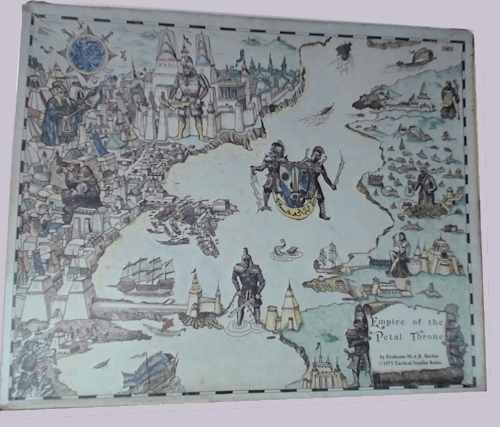
In 1974 I obtained, and first started to game master, White Box Dungeons and Dragons. A year later I got hold of the boxed set of Empire of the Petal Throne, with its massive, vinyl hex maps and interesting world setting. Obviously a new place to dungeon crawl and wild adventure through. And a world with unique properties that would change the way we role played!
Nope…
What Didn’t Work?
The mechanics of the game basically did not help to create the world of Tekumel, or adventures that suited it. Justin Alexander wrote about this kind of problem in System Matters.
Lets Look at the Rules
The actual rule set of Empire of the Petal Throne is a modified OD&D clone.
- For character Alignment, you are either good and serve the good gods, or evil and serve the evil gods.
- Classes: Warriors, Priests and Magic Users. They gain levels and hit dice, as well as spells. Level gain is through experience by taking loot and killing things.
- Magic spells, mostly combat oriented, and “magic” artifacts like flying cars and the more common magical eyes. These all mostly give battle oriented abilities, or some sneaking around and charm abilities
- A bestiary with mostly intelligent species that are native to Tekumel, or aliens (including humans), and a bunch of creatures for “the underworld”, which is Tekumel’s excuse for a dungeon under the city of Jackalla. All are mostly stat blocks with a brief paragraph about them.
- The simple combat rules of old D&D. There is a nod to fighting in the Hirilacte arenas, where wars are fought via champions instead of armies.
- Rules are provided for determining random encounters.
- There are treasure tables as in D&D, and what we would now call downtime rules for building strongholds, running fiefdoms and gathering minions.
That’s it.
No Tekumel in any depth.
What Would Be “Tekumel in Depth”?
The descriptive text paints a fascinating setting. In the far distant future humans, with some alien allies, colonize the planet Tekumel. They bring super technology akin to magic. The native intelligent species, prominently the Hsu and the Hlyss, are conquered and disenfranchised. About 25,000 years ago the whole solar system falls out of the normal universe into some pocket universe, cutting off supplies, like technology and even metals, and the power of the galactic economy. After some time “Gods” show up, able to do “Magic”, and they begin tinkering with the intelligent life on the planet for mysterious reasons of their own. The dark age sees empires rise up and shift, cultures develop and old animosities fester. A large legendarium grows.
So a game that is going to have a Tekumel feel needs a way to tie characters, and their goals, to the many levels of intrigue, conflict and legend in this world. The varied cultural complexities, social status concerns, faction allegiances and so on should flavor player choices.
Consider…
The ancient native species of Hsu and Hlyss are always fermenting struggles against the colonists, and various colonists groupings are from time to time enacting atrocities against the natives.
The Tsolyani imperial court has four major, interesting factions that are endlessly vying for position and power around the fabled Petal Throne.
The neighbors, especially Mu’uglaavyani, have political intrigues and schemes a plenty, with an eye on Tsolyani.
The gods are dabbling, throwing the good vs the bad, or sending folks on mysterious quests, upsetting or helping plans, as they see fit.
Even among the hoi polloi there are intrigues, poor vs rich, familly feuds, and self obsessed folks drawing the eye of the gods with terrifying consequences.
The mainstay here would be a set of rules for generating situations, and responding to player actions within the Tekumel milieu. A system of patronage that can result in players being offered work would make sense. Then as the players begin to understand their situation we could start using proactive methods to find and build on the players goals while fleshing out the world around them.
Start by Tossing the Mechanics
Right now I’m developing a Tekumel campaign, using the original game’s setting material as a source of truth, but throwing out the mechanics. Instead, I’m using my own AllUsGamersRPG rules. I designed them to be a set of mechanics that accommodates whatever reality that may be interesting to portray. You could replace the mechanics with alternatives such as BRP, or GURPS, which are both generic enough to allow the setting to dictate how they are used.
An important change is removing looting and murder hobo as the way to provide capability to a character. All these systems achieve that one way or another.
A major mechanical piece I am developing is for the use of “magic’, designed to fit the whole Empire of the Petal Throne stance on the reality of magic.
Spells of the Gods
The “Gods” have encased Tekumel in some form of unseen super technology environment that allows them to make miraculous changes in the world, from the point of view of the inhabitants. They grant the ability to “cast spells” to the intelligent creatures, largely as a way to serve their own mysterious interests.
Anyone in Tekumel can be granted spell casting ability for a limited duration. It requires the favor of the gods. So the first mechanism is building a relationship with gods. This means constant communion, either at a dedicated temple or shrine, or at greater difficulty somewhere else.
When communing a character may flatter the god, make offerings, recite deeds they have performed that would please the god and report on quests they have completed for the god. These acts may increase the characters favor, unless they do it poorly. Those with Priestly skills may do significantly better at this.
A communing character may also ask the god for a boon, either some spell casting power or a quest to perform that will earn favor. Requesting spell casting power tends to reduce favor even when such power is granted.
Spell casting power comes as a “casting budget” for different power levels of spell. Spells themselves have different minimum power level requirements, and may have enhanced effects if a stronger power level is used. The available spells are going to be dependent on which god is asked.
Its easier to gain favor from a cohort of a god than from the god themselves, although the power levels available from them are lower. A cohort may also grant the boon of interceding with their god on the character’s behalf.
The gods are jealous, so gaining favor with one god will make it harder to gain favor with others, especially if one god is “good” and the other “evil”.
Spells of Wizardry
A wizard is simply a person who has found a way to pull on some levers in the machinery of the God’s magic system. Anyone can become a wizard but to gain any wizard skill requires a difficult period of research and a break through, or training by another who is already a wizard. Wizards learn spells as specialization skills, so it will be rare for a wizard to have many such spells under their belt. Wizards will also need to perform the difficult task or drawing magical power to themselves so that they can empower the spells they have learned. In general this is not as fraught as seeking the favor of the gods.
Now, On To The Game…
The rest is not about play mechanics, but game master tools.
The first set of tools is going to be ones for prompting the design of conflict situations.
For example I can create a conflict basics selector:
D6
1 God vs God
2 God vs People
3 Kingdom vs Kingdom
4 Intrigue in the Halls of Power
5 Colonists vs Natives
6 Nature vs Civilisation
Use just one of these when you first start a campaign and work out the base elements, and consider how one of the elements in the conflict will hook the adventuring characters to become involved. Manage the player goals and get ahead of them with this (if you haven’t got it already I recommend getting The Game Master’s Handbook of Proactive Roleplaying). Making sure the gods are dynamic, full of mystery and mischief. And have them interfere at least tangentially in whatever the adventurers do.
As I develop the various pieces for my own campaign I may publish various mechanisms and techniques here. However if you want the details of the world of Tekumel you will need to look elsewhere.
2024 12 23 Update
I have been working on the process of being a supplicant, both when being in communion with a god and when being given an audience by a mortal of high status.
Seeking Favor
In both cases there are a list of deeds that the listener would like to hear about. Adventurers can note such deeds they perform while playing, and then recite them as a bonus to aptitude for the task when trying to gain favor. In addition characters may make gifts, to increase their task aptitude, that suit the one being wooed.
I’m starting with a simple results framework here. Firstly, when trying to gain favor there is a difficulty set by the game master depending on the target and their disposition. The difficulty may be reduced where there is a powerful advocate, but increased if you already have a lot of favor with the target or favor with a rival of the target. The character’s aptitude for the task will involve attributes like presence and determination, bonuses for reciting exalted deeds, the provision of appropriate gifts and for skill spheres such as priestly skills or court skills. Then the outcome after rolling dice and possibly using focus will be something like:
| Result | Effect |
| Incredible Success | Gain a significant increase in favor (+4) |
| Extra Success | Gain a good increase in favor (+2) |
| Success | Gain an increase in favor (+1) |
| Failure | No gain. |
| Miserable Failure | Lose some favor (-2) and sense the target is displeased, requiring a determination check before the next attempt at gaining favor. |
| Disaster | Lose lots of favor (-6) and sense the target is very displeased, requiring a formidable determination check before the next attempt at gaining favor. |
Seeking a Boon
When seeking a boon from a mortal being of high status characters may seek access to knowledge, equipment and other resources, personnel and a service to complete for their patron. Such people may also advocate for you with others that they themselves have sway with, including with gods who’s favor they hold.
When seeking a boon from the gods, then characters may seek knowledge, spell power budgets and a quest to complete for the god. Cohorts may be asked to advocate for you with their significant other, and any god may be asked to advocate for you with mortals.
When asking for a boon the difficulty will be set by the size of the benefit sought, if it is in the power of the benefactor to provide easily and aligns with their interests. The aptitude will revolve around persuasive skills and attributes, and the level of favor the supplicant has with their benefactor.
Outcomes
| Result | Effect |
| Incredible Success | Boon is granted |
| Extra Success | Boon is granted but favor is reduced by 1 |
| Success | Boon is granted but favor is reduced by 2 |
| Failure | Boon is not granted and favor is reduced by 4 |
| Miserable Failure | Boon is not granted and favor is reduced by 6, and sense the target is displeased, requiring a determination check before the next attempt at requesting a boon. |
| Disaster | Boon is not granted and favor is reduced by 8, and sense the target is very displeased, requiring a formidable determination check before the next attempt at requesting a boon. |
Favor will be allowed to go below zero, indicating that the character is now heavily in the bad books with that potential patron.
Christmas Update
Scanning for old stuff beyond the original RPG. The home of all things Tekumel is Tekumel : The World of the Petal Throne. It has stuff from old fanzines, references to all sorts of fan fiction and a database about the world. It also points to the game rules book Tékumel: Empire of the Petal Throne, published later and consolidating much of the world knowledge built up over the years. Reading reviews it still suffers from a failure to really provide game master tools for building solid adventures. Anyway, I’m unlikely to find out as old copies are trading for over $800 AUD. I’ll keep trawling the other sources though.
 Strange Flight